
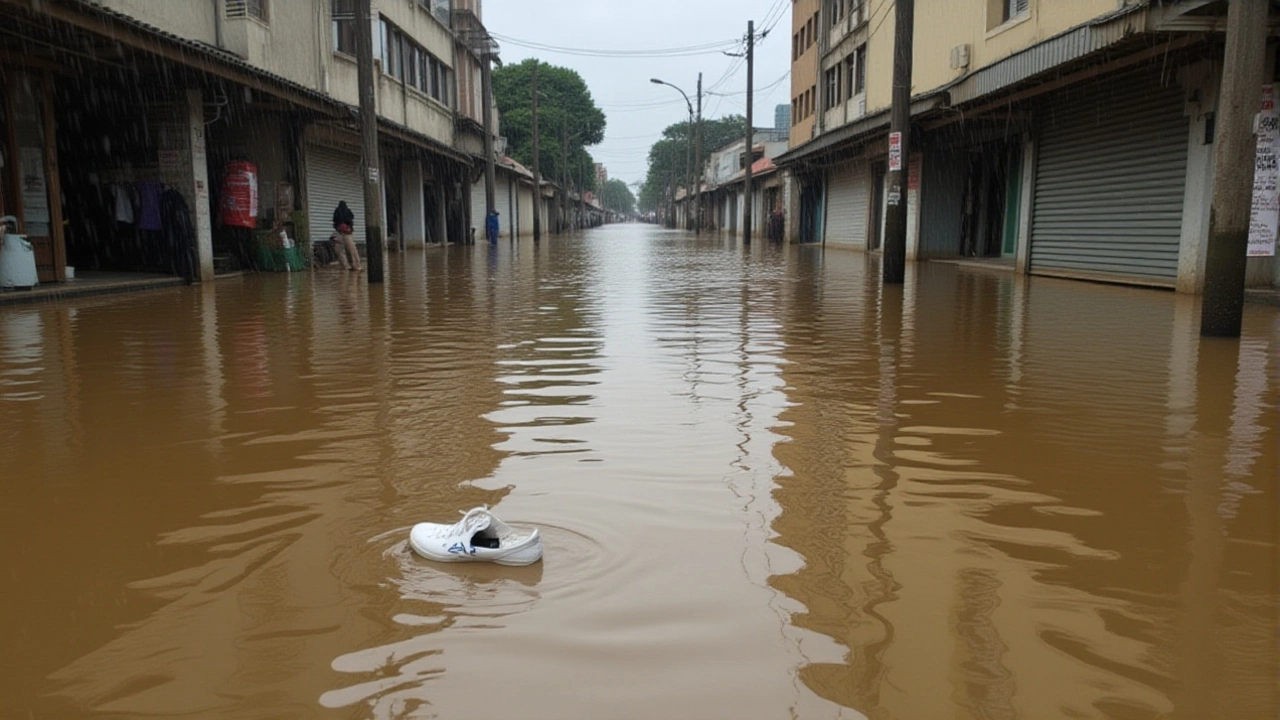
On March 10, 2025, a sudden deluge turned Nairobi County, the Central Highlands, the Lake Victoria Basin and swaths of the Rift Valley into a patchwork of water‑logged streets and displaced families. David Gikungu, Director of the Kenya Meteorological Department confirmed that rainfall peaked around 2:30 PM East Africa Time, and the Kenya Red Cross Society reported “widespread disruption and temporary displacement of many families.” The Emergency Bulletin KEN: Flood - 03-2025Nairobi County issued by the International Federation of Red Cross and Red Crescent Societies (IFRC) warned that downpours would linger through the week.
Overview of the March Floods
Here’s the thing: the rain didn’t just fall in isolated pockets – it hammered a broad arc from the western highlands to the eastern lake shore. In the capital, informal settlements along the tributaries of the Nairobi River were the first to drown, with dozens of makeshift homes swept away. Further west, the Central Highlands saw roads buckle under five‑inch water columns, halting the transport of fresh produce to markets. Meanwhile, the Lake Victoria Basin, home to over ten million people, experienced flash flooding that inundated low‑lying farms and forced schools to close.
The twist is that the flooding aligns with a regional pattern spotted by the Intergovernmental Authority on Climate Prediction and Applications Centre (ICPAC). Earlier this year, the centre’s March‑May outlook had projected below‑normal rains for much of the Greater Horn of Africa, yet its own Weather Research and Forecasting Model hinted at “pockets of heavy rainfall” in early March. That mismatch left disaster planners scrambling.
Meteorological Forecasts vs. Reality
Back on January 29, 2025, David Gikungu presented the seasonal forecast: the Lake Victoria Basin and South Rift Valley were slated for “near to above‑average rainfall,” while the Highlands east of the Rift – which include Nairobi – were expected to see “near to below‑average rainfall with occasional dry spells.” Fast forward three months, and Nairobi is drowning while some of the predicted rain‑rich zones have only seen moderate showers.
Why the surprise? Climate scientists say a “dry antecedent” – an unusually hot, arid January that left soils cracked – can amplify runoff when the rains finally arrive. The World Bank’s climate analysis notes Kenya’s mean temperature has risen about 1.0 °C since the 1960s, with the steepest climb during the March‑May “spring” season. That extra heat turns any rain into a torrent rather than a gentle soak.
Dr. Abdi Fidar, Officer in Charge at ICPAC, told the Greater Horn of Africa Climate Outlook Forum (GHACOF 74) in Nairobi that “the region is experiencing increasing climate variability – droughts, floods, and hotter temperatures – and platforms like GHACOF are essential for building shared risk understanding.” His words echo a growing consensus: historical patterns are no longer reliable guides.
Humanitarian Response on the Ground
As the water receded, the Kenya Red Cross Society mobilised 350 volunteers to set up temporary shelters in schools and community halls. “We’re seeing families displaced for days, sometimes weeks,” said the society’s field coordinator, Mary Wambui, who prefers not to be named in official releases. The IFRC’s emergency bulletin called for $2.3 million in immediate aid to cover food, clean water, and medical supplies.
But wait – the National Disaster Operation Centre (NDOC) is also stepping in, coordinating with the Ministry of Water and Sanitation to restore damaged pipelines. In the Rift Valley, the Ministry of Transport announced a temporary suspension of freight routes until bridges are inspected, affecting the movement of maize destined for the south.
Children are the most vulnerable. Local health posts report a spike in diarrheal cases, a classic symptom after floods. UNICEF‑Kenya has dispatched rapid‑response teams to distribute oral rehydration salts and educate mothers on safe water practices.
Climate Context and Past Droughts
To understand today’s flood, you have to look back at the 2020‑2023 drought that devastated Turkana County. Herds perished, and the loss of livestock pushed thousands into food insecurity. That drought, followed by an unusually scorching January 2025 – where temperatures topped 38 °C in Nairobi – set the stage for the current crisis. When the rain finally broke, the parched ground could not absorb it, leading to the rapid overflow of rivers like the Tana.
According to the Climate Reality Project, Kenya now warms faster than the global average, a trend that fuels both extremes. The project’s data show that “heavy rainfall events cause rivers to overflow, flooding settlements and destroying crops,” exactly what’s happening in the Lake Victoria Basin’s banana farms.
Experts warn that this swing from drought to flood could become the new normal. Professor Samuel Olal of the University of Nairobi’s Climate Change Institute notes, “If greenhouse‑gas emissions continue at current rates, we’ll see more frequent ‘rain‑on‑dry‑soil’ events that the country’s infrastructure simply isn’t built to handle.”
Looking Ahead: What’s Next?
The IFRC bulletin projects “continued heavy downpours through mid‑March.” That means relief agencies must shift from emergency shelter to longer‑term recovery. The government is drafting a “Climate‑Resilient Urban Planning” guideline for Nairobi, which would require flood‑plain mapping and stricter building codes.
Meanwhile, the Kenya Meteorological Department is upgrading its radar network to provide real‑time alerts. “We’re moving from weekly forecasts to hourly warnings,” Gikungu promised, hinting at a potential satellite‑based system.
In the broader region, the IGAD (Intergovernmental Authority on Development) plans a July summit to discuss a cross‑border early‑warning protocol, a move praised by H.E. Mr. Motumma Mekasa, Ethiopia’s State Minister and Advisor to the Minister of Water and Energy.
For the families whose lives have been turned upside‑down, the immediate concern is simple: food, clean water, and a roof that won’t collapse when the next storm hits.
Key Facts
- Rainfall began at 2:30 PM EAT on 10 March 2025, affecting Nairobi, Central Highlands, Lake Victoria Basin and Rift Valley.
- Over 3,500 families reported displaced; 12 schools used as shelters.
- IFRC seeks $2.3 million in emergency aid; Kenyan government mobilises NDOC and Ministry of Water.
- Temperature rise of ~1.0 °C since 1960s, accelerating flood risk.
- Future forecasts predict heavy rain through mid‑March, prompting calls for resilient infrastructure.
Frequently Asked Questions
How are the floods affecting agriculture in the Lake Victoria Basin?
Farmers report that rising waters have submerged up to 70 % of their banana and maize fields, washing away seedlings and delaying harvests. The loss threatens food security for an estimated 1.2 million residents, and aid groups are distributing seed kits to help replant once fields dry.
What caused the discrepancy between the meteorological forecast and the actual rainfall in Nairobi?
A combination of an unusually hot, dry January that hardened the soil and a rapid shift in atmospheric moisture patterns led to intense, short‑duration storms. The forecast model anticipated “near‑to‑below‑average” rain for Nairobi, but it could not fully capture the sudden convective bursts that developed over the city.
Which agencies are coordinating the humanitarian response?
The response is led by the Kenya Red Cross Society, the International Federation of Red Cross and Red Crescent Societies, the National Disaster Operation Centre, UNICEF‑Kenya, and the Ministry of Water and Sanitation. International donors are also being mobilised through the IFRC emergency bulletin.
What long‑term measures are being discussed to reduce flood risk?
Kenya’s government is drafting climate‑resilient urban planning guidelines, upgrading river‑bank reinforcement, and expanding early‑warning systems. Regionally, IGAD is planning a cross‑border flood‑early‑alert protocol to help neighbouring countries share data in real time.
How are health services coping with the surge in water‑borne diseases?
Local clinics have seen a 45 % rise in diarrheal cases. UNICEF has deployed rapid‑response health teams, providing oral rehydration salts and educating communities on safe water storage. The Ministry of Health is also distributing chlorine tablets to disinfect drinking water.





Comments
Lois Parker
October 24, 2025 AT 19:22 PMLooks like the sky finally remembered it had water, and Nairobi paid the price. Maybe we should ask the clouds to be more punctual next time.
Lerato Mamaila
November 3, 2025 AT 18:22 PMIndeed, the floods remind us how interconnected our ecosystems are-when one region suffers, the ripple effects touch us all. Solidarity across borders is essential.
Dennis Lohmann
November 13, 2025 AT 18:22 PMStay safe, everyone! If you’re in a flooded area, try to move to higher ground and keep your phones charged. 📱 Remember, community help circles can share resources quickly.
Jensen Santillan
November 23, 2025 AT 18:22 PMThe systemic failure is glaring; our predictive models are as outdated as last decade’s climate treaties. It’s not merely “heavy rain” – it’s a manifestation of policy inertia and academic complacency.
Mike Laidman
December 3, 2025 AT 18:22 PMThe response appears insufficient; funding gaps remain.
J T
December 13, 2025 AT 18:22 PMEnough with the talk-send the aid now 😤.
A Lina
December 23, 2025 AT 18:22 PMFrom a risk‑assessment standpoint, the failure to integrate hydrological modeling into urban planning constitutes a critical governance lapse, exacerbating vulnerability metrics across the basin.
Virginia Balseiro
January 2, 2026 AT 18:22 PMCan you feel the thunder of change? This flood is a wake‑up call, a roaring reminder that we must rebuild stronger, greener, and with heart!
Jared Mulconry
January 12, 2026 AT 18:22 PMI hear the concerns; let’s focus on collaborative solutions rather than blame.
Brandon Rosso
January 22, 2026 AT 18:22 PMWhile the situation is dire, coordinated action and strategic investment can transform this crisis into an opportunity for resilient infrastructure development.
Tracee Dunblazier
February 1, 2026 AT 18:22 PMIt’s clear that prior warnings were overlooked, yet we must now concentrate on recovery efforts.
Edward Garza
February 11, 2026 AT 18:22 PMThe agencies’ coordination looks chaotic, nothing solves the root cause.
Allen Rodi
February 21, 2026 AT 18:22 PMFirst, ensure that all displaced families have access to clean drinking water; point‑of‑use purification tablets can be distributed quickly.
Second, establish temporary sanitation stations away from floodwaters to prevent disease outbreaks.
Third, coordinate with local health clinics to monitor diarrheal cases and provide oral rehydration solutions.
Fourth, set up a community information hub using radio and mobile alerts to keep residents updated on weather forecasts and aid distribution points.
Fifth, prioritize the restoration of critical road segments that connect markets to agricultural zones, enabling food supplies to flow back into affected areas.
Sixth, engage local NGOs to assist with shelter construction, ensuring structures are elevated and anchored to resist future floods.
Seventh, conduct rapid assessments of damaged infrastructure, mapping out which bridges and pipelines need immediate repair.
Eighth, launch a cash‑for‑work program that not only provides income to flood‑hit families but also mobilizes labor for debris clearance.
Ninth, leverage the updated radar network from the Meteorological Department to issue hourly flood warnings, giving communities more lead time.
Tenth, integrate climate‑resilient urban planning guidelines into Nairobi’s zoning laws, restricting development in high‑risk floodplains.
Eleventh, promote agro‑forestry and soil‑conservation practices in the Rift Valley to improve water infiltration and reduce runoff.
Twelfth, secure additional funding from international donors by presenting clear, data‑driven impact assessments of the current response.
Thirteenth, involve community leaders in decision‑making to ensure aid distribution aligns with local needs and cultural practices.
Fourteenth, monitor mental health impacts and provide psychosocial support services for those traumatized by the flooding.
Finally, establish a post‑disaster evaluation committee to review what worked and what didn’t, feeding lessons learned into future disaster preparedness plans.
Jody Webster
March 3, 2026 AT 18:22 PMWell… maybe it's not just the rain-! perhaps we should've blamed the turtles?!!
Steve Goodger
March 13, 2026 AT 18:22 PMFriends, I’d like to emphasize that resilience is built not only through infrastructure but also through community cohesion. When neighbors share resources, the collective capacity to recover increases dramatically. It’s essential to document personal stories from the flood zones, as they provide valuable insight for future planning. Moreover, partnering with local schools to educate children on climate adaptation can sow seeds of long‑term change. Let’s also remember to thank the volunteers who are working tirelessly under challenging conditions. Together, we can transform hardship into a catalyst for sustainable development.
johnson ndiritu
March 23, 2026 AT 18:22 PMThe complacency of policymakers is unforgivable; they chose rhetoric over action, and now vulnerable families pay the price 😡. It’s a moral failing that can no longer be ignored.
sheri macbeth
April 2, 2026 AT 19:22 PMOh sure, the floods are just “natural,” said the guy who also thinks the moon landing was staged-right? 🙄
Lane Herron
April 12, 2026 AT 19:22 PMBehold the spectacular theatre of bureaucratic inertia-hand‑waving committees delivering “strategic frameworks” while rivers rage unchecked. It’s a masterpiece of denial and obfuscation.
Henry Cohen
April 22, 2026 AT 19:22 PMHonestly nobody told you the real cause is the new satellite feed glitch – that’s why forecasts missed it.