
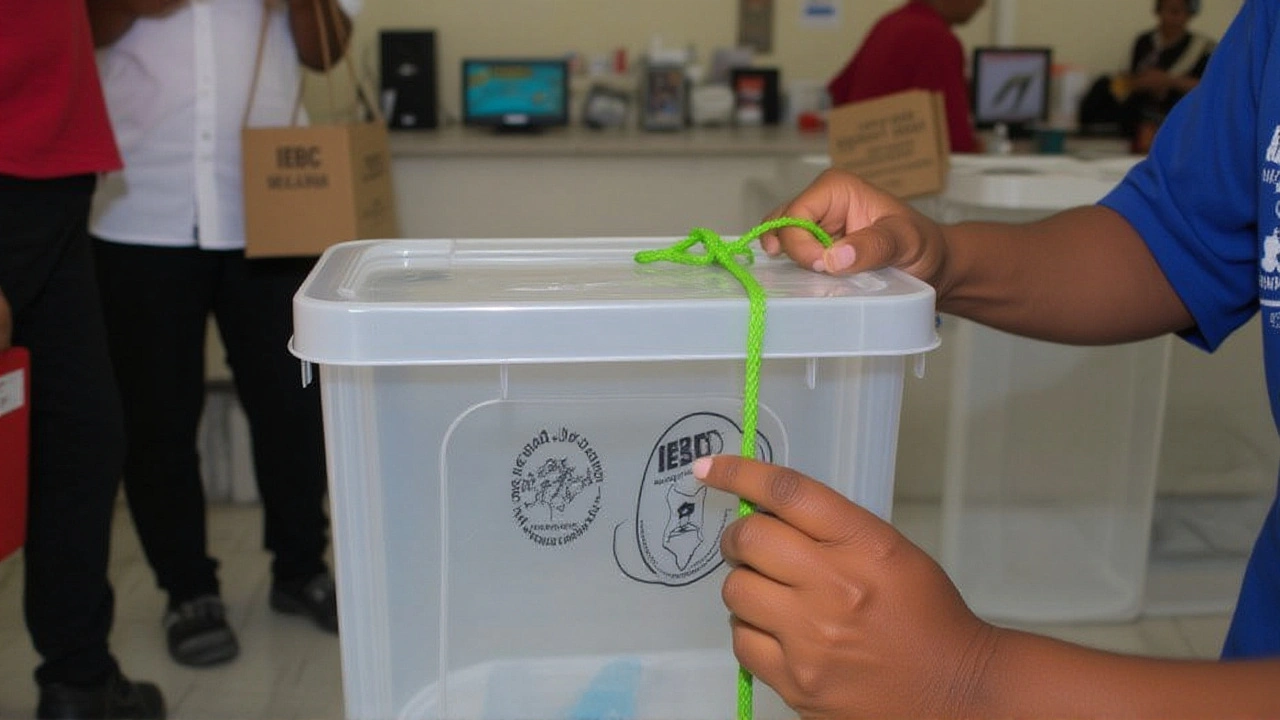
When Erastus Ethekon, Chairperson of Independent Electoral and Boundaries Commission unveiled the new continuous voter registration drive on 29 September 2025, Kenya’s political calendar got a jolt. The plan is to swell the voter roll from the current 22.1 million to a staggering 28.5 million by the 2027 General ElectionKenya, slated for 10 August 2027. That’s an extra 6.3 million eligible citizens, most of them fresh‑face youths, who will have the chance to shape the nation’s future.
Why the new drive matters
The numbers matter because Kenya’s last two elections saw the roll‑off rate climb into double‑digit percentages, especially among 18‑ to 25‑year‑olds. By targeting 70 % of the new registrants as youth, the commission hopes to curb that trend and give a louder voice to the generation that will inherit the country’s challenges.
President William Ruto, who gazetted the reconstituted commission in July 2025, has repeatedly stressed that “sovereignty belongs to the people, and it begins with voter registration.” The fresh push is therefore more than a numbers game – it’s a political promise to broaden participation.
How the registration will work
Citizens aged 18 or older must swing by any IEBC constituency office (except those currently holding the 27 November 2025 by‑elections) armed with a valid national ID card or Kenyan passport. There, volunteers will guide them through a short form, capture fingerprints, facial images, and, for the first time, an iris scan.
Applicants also have the chance to correct existing details, transfer their registration to a new polling station, or verify their information. The entire continuous voter registration (CVR) effort will run until a few months before the 2027 polls, after which a massive audit and clean‑up will lock the final list.
Tech upgrade: biometric and iris scanning
The commission’s tech arm has integrated a new module into the Kenya Integrated Election Management System (KIEMS). The system now records iris patterns alongside fingerprints and facial features, creating a triple‑layer identity check.
“Our BVR kits are configured to take into account all those identifiers which are unique to an individual,” Ethekon explained. “That’s why we do the fingerprints but also the facial features, and now iris recognition, to ensure the person registered is indeed the right person.”
Privacy watchdogs will monitor the process under the Data Protection Act, a move that the commission says will safeguard personal data while enhancing election integrity.
Funding and budget
- Sh8 billion earmarked specifically for the registration drive.
- Overall election budget stands at Sh57.3 billion.
- Funding covers new kiosks, training, logistics, and the biometric hardware.
Analysts note that while the allocation is sizable, the cost per new voter (roughly Sh1,270) is comparable to other African nations undertaking similar expansions.

Reactions from stakeholders
Political parties have greeted the initiative with cautious optimism. A senior official from the ruling party said, “If the commission can truly reach the grassroots, especially in remote villages, it will level the playing field.” Opposition leaders, however, urged tighter oversight, warning that “technology is only as good as the people who operate it.”
Civil society groups highlighted the importance of the youth focus, noting that “a politically engaged young electorate could reshape policy priorities on education, jobs, and climate.”
Implications for the 2027 election
Should the target be met, the 2027 General Election could see a turnout surge of up to 12 percentage points compared with 2022. The expanded roll is also expected to shift constituency boundaries during the next delimitation, potentially redrawing political strongholds.
Moreover, the data‑driven approach—relying on National Registration Bureau records rather than census figures—signals a move toward more precise electoral planning, which could reduce disputes over voter eligibility.
Key Facts
- Launch date: 29 September 2025.
- Goal: Add 6.3 million new voters, reaching 28.5 million total.
- Budget: Sh8 billion for registration, part of a Sh57.3 billion election budget.
- Technology: New biometric kits with iris recognition via KIEMS.
- Target demographics: 70 % youth (18‑30 years).
Frequently Asked Questions
How does the registration drive affect first‑time voters?
First‑time voters, especially those aged 18‑25, will have dedicated kiosks at every constituency office. The inclusion of iris scanning aims to reduce duplicate registrations, making it easier for young Kenyans to secure a single, verified entry on the roll.
What documents are required to register?
Applicants must present either a valid Kenyan National ID card or a Kenyan passport. Those without either can apply for an ID at the nearest registration bureau before visiting an IEBC office.
Will the new biometric system be used in future elections?
Yes. The commission plans to retain the iris‑enabled BVR kits for the 2027 polls and any subsequent elections, as they provide an extra layer of security against fraud and impersonation.
How is the registration drive funded?
A dedicated Sh8 billion has been set aside within the IEBC’s total Sh57.3 billion election budget. The funds cover hardware, staff training, logistics, and public awareness campaigns.
When will the final voter roll be published?
The finalized roll is expected to be released a few months before the 10 August 2027 General Election, after a comprehensive audit and cleanup process.





Comments
Balaji Srinivasan
September 29, 2025 AT 20:29 PMIt's encouraging to see the IEBC taking concrete steps to bring more young Kenyans onto the roll. Expanding the register while adding biometric safeguards could really boost confidence in the process.
Vibhor Jain
October 9, 2025 AT 21:56 PMSure, a shiny new iris scanner will magically fix every registration hiccup, right? The reality, of course, is far messier.
vikash kumar
October 19, 2025 AT 17:49 PMThe allocation of Sh8 billion, representing roughly 14 % of the total electoral budget, appears proportionate given the projected cost per additional registrant. Nonetheless, the efficacy of such expenditure warrants rigorous post‑implementation audit.
Anurag Narayan Rai
October 29, 2025 AT 12:43 PMIt is absolutely vital that Kenya safeguards its sovereign right to determine its electoral future without foreign interference, and this push for a massive voter registration drive is a testament to our national pride.
By harnessing cutting‑edge biometric technology, we demonstrate our capability to manage our own democratic processes with integrity and precision.
Moreover, empowering the youth en masse will ensure that the next generation can steer the nation toward prosperity, free from the shackles of outdated political patronage.
This is not just an administrative exercise; it is a bold statement that Kenya will not be dictated by external forces that seek to manipulate our elections.
The sheer scale of adding 6.3 million voters showcases our resolve and determination to build a truly representative democracy.
Let us remember that every fingerprint, facial scan, and iris pattern is a symbol of our identity as Kenyans, a badge of our collective sovereignty.
We must remain vigilant, however, to ensure that the deployment of these technologies does not open doors to surveillance that could be weaponized against our own people.
In the hands of a transparent, accountable commission, these tools become a shield rather than a sword.
The anticipation of a higher turnout, especially among the energetic youth, is a promising sign that our political culture is evolving for the better.
As we approach the 2027 General Election, this initiative stands as a cornerstone for a more inclusive and resilient democratic framework.
The success of this drive will also set a precedent for future electoral reforms across the continent, showcasing Kenya as a model for technological integration in governance.
Continuous public education will be essential to ensure citizens understand the benefits and privacy safeguards of the new system.
Robust audit mechanisms must be in place to verify that each new registration is legitimate and free from duplication.
The political parties, too, have a responsibility to respect the integrity of the process and refrain from exploiting the expanded roll for partisan gain.
Ultimately, a vibrant, well‑registered electorate is the bedrock of any thriving democracy.
Kiran Singh
November 8, 2025 AT 08:36 AMSuper excited to see more youth voices! 🎉 This could really shift the political conversation toward education and jobs. Keep it up! 😊
deepika balodi
November 18, 2025 AT 04:29 AMThe focus on iris scanning adds a solid layer of security.
Priya Patil
November 28, 2025 AT 00:23 AMAbsolutely, the added security measures are a step forward. It’s also great that the campaign includes outreach in remote areas, ensuring nobody gets left behind.
Maneesh Rajput Thakur
December 7, 2025 AT 20:16 PMWhile the budget looks reasonable on paper, one must consider the potential for data misuse. Centralised biometric databases are attractive targets for both internal and external actors, and oversight mechanisms often lag behind technology deployment.
ONE AGRI
December 17, 2025 AT 16:09 PMIt is absolutely vital that Kenya safeguards its sovereign right to determine its electoral future without foreign interference, and this push for a massive voter registration drive is a testament to our national pride. By harnessing cutting‑edge biometric technology, we demonstrate our capability to manage our own democratic processes with integrity and precision. Moreover, empowering the youth en masse will ensure that the next generation can steer the nation toward prosperity, free from the shackles of outdated political patronage. This is not just an administrative exercise; it is a bold statement that Kenya will not be dictated by external forces that seek to manipulate our elections. The sheer scale of adding 6.3 million voters showcases our resolve and determination to build a truly representative democracy. Let us remember that every fingerprint, facial scan, and iris pattern is a symbol of our identity as Kenyans, a badge of our collective sovereignty. We must remain vigilant, however, to ensure that the deployment of these technologies does not open doors to surveillance that could be weaponized against our own people. In the hands of a transparent, accountable commission, these tools become a shield rather than a sword. The anticipation of a higher turnout, especially among the energetic youth, is a promising sign that our political culture is evolving for the better. As we approach the 2027 General Election, this initiative stands as a cornerstone for a more inclusive and resilient democratic framework. The success of this drive will also set a precedent for future electoral reforms across the continent, showcasing Kenya as a model for technological integration in governance. Continuous public education will be essential to ensure citizens understand the benefits and privacy safeguards of the new system. Robust audit mechanisms must be in place to verify that each new registration is legitimate and free from duplication. The political parties, too, have a responsibility to respect the integrity of the process and refrain from exploiting the expanded roll for partisan gain. Ultimately, a vibrant, well‑registered electorate is the bedrock of any thriving democracy.
Himanshu Sanduja
December 27, 2025 AT 12:03 PMGreat progress on the biometric rollout, and I hope the training for volunteers matches the technology's sophistication.
Hariprasath P
January 6, 2026 AT 07:56 AMi think the new iriz scan is kinda cool but hope they dont mess up the data.
Rashi Nirmaan
January 16, 2026 AT 03:49 AMThe expansion of the electoral roll must be accompanied by stringent oversight to preserve the sanctity of the voting process.
Ashutosh Kumar Gupta
January 25, 2026 AT 23:43 PMHonestly, if the commission can't manage this rollout flawlessly, the entire election could be compromised.
fatima blakemore
February 4, 2026 AT 19:36 PMLife's like a ballot – you choose, you stand, and you hope the system respects your voice.
Sandhya Mohan
February 14, 2026 AT 15:29 PMIndeed, every added voter is a step toward a more inclusive society.
Prakash Dwivedi
February 24, 2026 AT 11:23 AMThe sheer volume of data being collected raises legitimate concerns about long‑term privacy and governmental overreach.
Rajbir Singh
March 6, 2026 AT 07:16 AMData security is key. The commission should lock it down tight.
Swetha Brungi
March 16, 2026 AT 03:09 AMIt's fascinating to see technology intersect with civic duty; this could inspire a new generation to view voting as both a right and a responsibility. The outreach component will be crucial for reaching those in remote areas.
Govind Kumar
March 25, 2026 AT 23:03 PMYour observations underline the importance of procedural transparency; I concur that meticulous audit processes will be essential to uphold electoral integrity.